
Project Overview
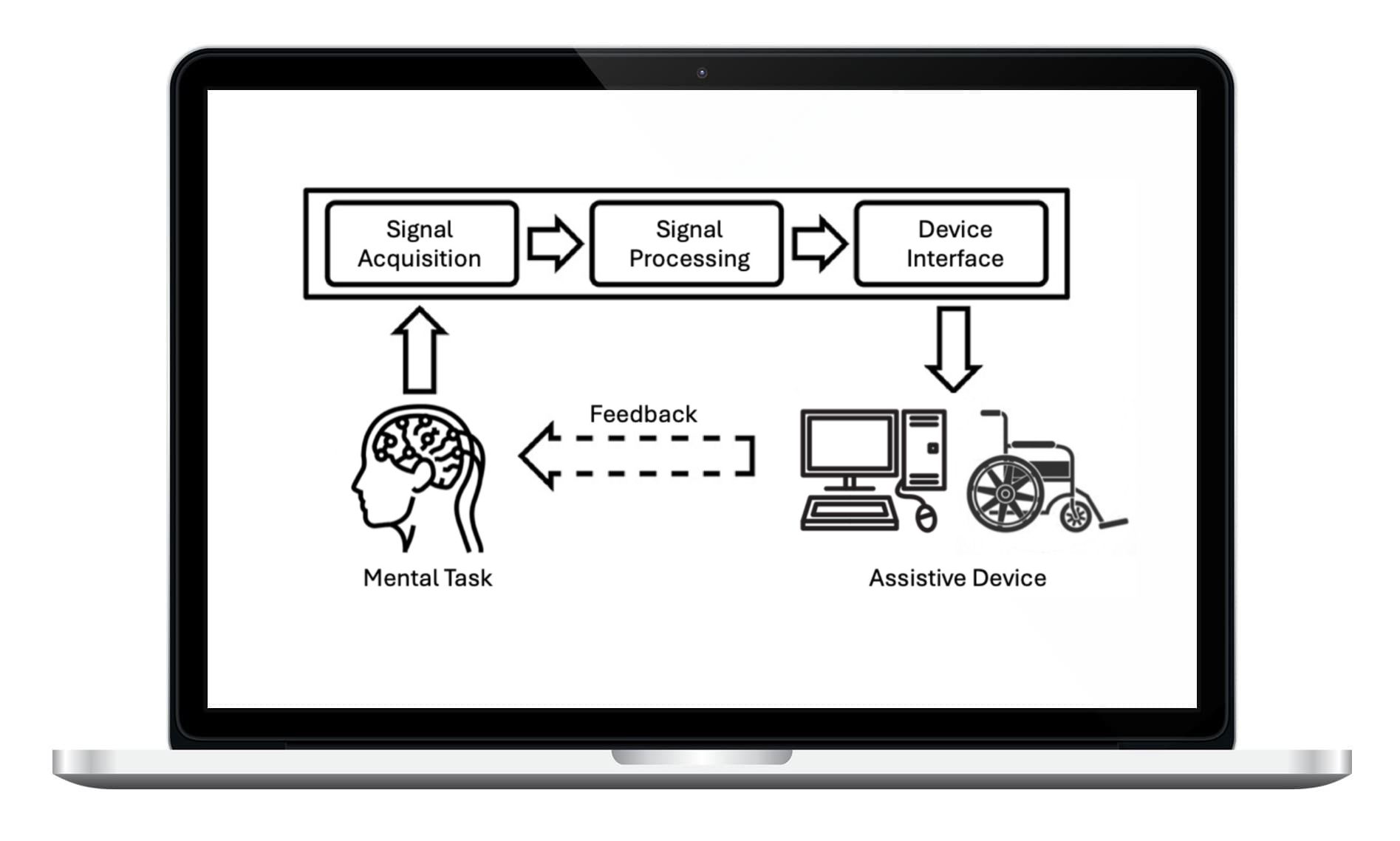
Brain-Computer Interfaces (BCIs) represent the ultimate bridge between human cognition and machine execution. This project focuses on Motor Imagery (MI) decoding—identifying a user's intention to move loro hands just by analyzing brain's electrical activity (EEG) captured via noisy sensors.
The core challenge was the extremely low Signal-to-Noise Ratio (SNR) of EEG data. I implemented and compared two distinct pipelines: a classical approach using Common Spatial Patterns (CSP) combined with LDA, and a state-of-the-art Deep Learning approach using EEGNet, a compact convolutional neural network specifically designed for BCI applications.
Key Technical Milestone
A major focus was Subject-Independent training, a high-difficulty task where the model must generalize across different brain architectures without prior calibration on the specific user. I achieved competitive accuracy benchmarks on the BCI Competition IV 2a dataset, demonstrating the robustness of the chosen architectures.
By visualizing neural topomaps and frequency bands (Mu/Beta rhythms), I validated that the models were truly listening to the motor cortex rather than picking up muscle artifacts or electrical noise, ensuring the physiological validity of the neural intentions decoded.
For a deep dive into my analytical process, the GitHub repository includes all the Jupyter Notebooks, preprocessing steps, and detailed statistical analyses conducted throughout the project.