
Project overview
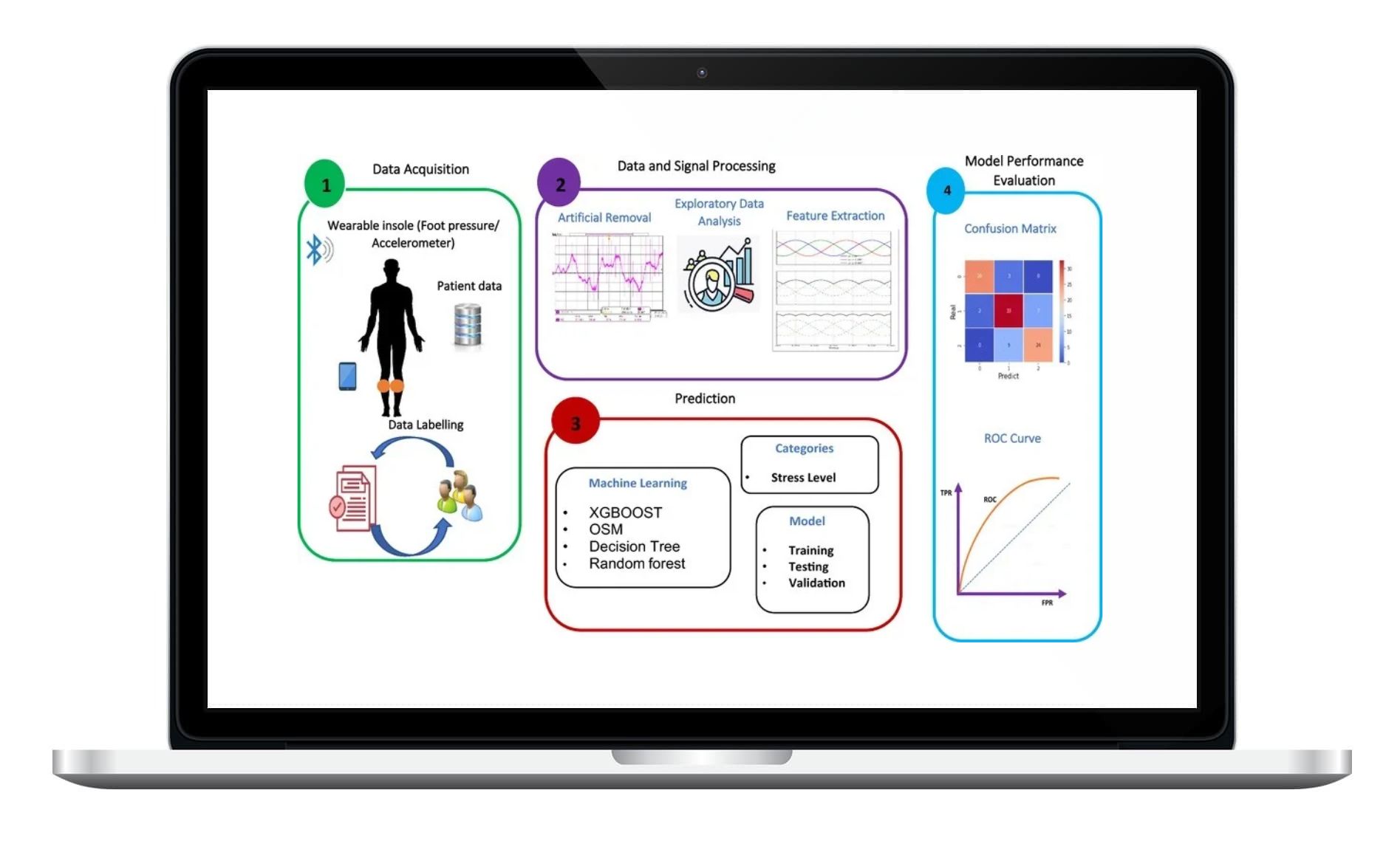
This project investigates whether wrist and chest physiological signals can distinguish baseline, stress, and amusement in unseen participants. Using the WESAD dataset, introduced by Schmidt and colleagues, I developed a workflow spanning signal-quality assessment, feature engineering, machine-learning evaluation, and interpretation of individual predictions.
The central challenge was variability between people: a model that recognizes patterns in familiar recordings may struggle with a new participant. I used leave-one-subject-out evaluation with participant-grouped inner validation, keeping preprocessing and hyperparameter tuning within the training participants.
A Cognitive Neuroscience perspective
My background in Cognitive Neuroscience informed the distinction between experimental conditions, peripheral physiology, and subjective experience. These measurements are related, but they are not interchangeable. I incorporated exploratory self-report analyses to investigate associations with physiological features and held-out model outputs, without using the questionnaires as classifier-training labels.
Modeling strategy and sensor fusion
I benchmarked logistic regression, Random Forest, XGBoost, LightGBM, and MLP against a majority-class reference. The analysis compared wrist-only, chest-only, and combined inputs on matching valid windows. Exploratory extensions included late fusion, simulated missing-modality scenarios, binary stress tasks, and a four-class task including meditation.
A separate feature-redundancy sensitivity analysis evaluated correlation filters at 0.95, 0.90, and 0.80, fitted inside the training folds. The benchmark checked metrics directly from saved out-of-fold predictions and compared precision, recall, F1, and balanced accuracy without mixing different prediction tasks.
Key findings and interpretation
Exploratory late fusion achieved 73.3% balanced accuracy on the three-class task. Early-fusion Random Forest with the 0.90 correlation filter reached 72.4%, using approximately 35 rather than 45 features. Their paired comparison did not establish a clear advantage for either candidate. On the separate stress/non-stress task, wrist logistic regression reached 90.3% balanced accuracy.
Results highlighted an important limitation: aggregate performance can conceal class-specific errors and large individual differences. Amusement remained difficult, while confidence-based rejection sometimes removed entire classes for a participant. I therefore examined both prediction quality and the proportion of decisions the system retained.
Explainability and analytical transparency
The interpretation workflow uses Monte Carlo estimates of Shapley values to explain saved models on held-out participants, supported by beeswarm and waterfall plots, physiological feature-group summaries, and PDP/ALE visualizations. These analyses describe how the models use their inputs; they do not establish physiological causes of stress.
The project is an independent analysis of laboratory WESAD recordings, not a clinically validated or real-world stress-monitoring system. Model rankings remain conditional on this sample and evaluation design.
For a deep dive into my analytical approach to the signal-processing pipeline, LOSO experiments, statistical analyses, and interpretability workflow, visit the GitHub repository.
Dataset and original research
Schmidt, P., Reiss, A., Dürichen, R., Marberger, C., and Van Laerhoven, K. (2018). Introducing WESAD, a Multimodal Dataset for Wearable Stress and Affect Detection. ICMI, 400–408. Original paper. Dataset: Schmidt, P., and Reiss, A. (2018), WESAD, UCI Machine Learning Repository. Dataset collection and experimental design are credited to the original authors.